
A Mistress’s Guide to Suspension Bondage
As a submissive, there's nothing more satisfying than feeling beautifully, completely, and rather helplessly fucked.
Being cuffed to a bed, tied at the wrists, or kept kneeling at Mistress’s feet can be both restrictive and pleasurable, yes. But suspension bondage? Suddenly, your body is no longer fully yours to control. It also looks visually appealling, feels incredibly intense, and can be one of the most powerful forms of rope play. That being said, it also carries far more risk than basic restraint. This guide has been put together with advice inspired by the experienced BDSM escorts London has to offer, many of whom understand exactly how to make a submissive feel vulnerable, displayed, controlled, and safely looked after.
So, if you’re curious about suspension bondage, or wondering whether your body is ready to become a Mistress’s dangling little toy, here’s what you need to know before your feet leave the floor.
Contents:
- What Is Suspension Bondage?
- Partial vs Full Suspension
- The Main Suspension Positions
- Suspension Rings, Cuffs, Rope & Equipment
- What Rope Should Be Used for Suspension?
- Chest, Hip, Thigh & Ankle Harnesses
- How to Tie Off a Suspension Ring
- Can Beginners Try Suspension Bondage?
- Aftercare Once You’re Back on the Ground
- Ready to Explore Suspension Bondage?
What Is Suspension Bondage?
Suspension bondage is a form of BDSM rope play where the submissive is tied, supported, and lifted using ropes, cuffs, chains, or specialist rigging equipment. Instead of simply being restrained on a bed, chair, bench, or floor, the body is partially or fully supported from above.
Suspension is often associated with Shibari, the Japanese-inspired art of rope bondage, although not every suspension scene is artistic or ceremonial. You might be displayed face down, legs parted, chest harness tight, while Mistress circles you like she's admiring her work. You might be lifted just enough to make your toes search desperately for the floor. Or, if you're experienced enough, you might be fully suspended with no contact beneath you at all. For many submissives, that feeling is intoxicating... making them feel exposed, owned, objectified, displayed, used, admired, inspected, and utterly dependent on Mistress.
Erotic, yes, but the important thing to remember is that suspension bondage is advanced restraint play. The ropes, after all, support body weight, create pressure, affect circulation, and place stress on muscles, joints, nerves, and skin. That's why proper knowledge and experience are very important when indulging in such a fantasy.
If you're still new to restraint play, start with our beginner’s guide to sexual bondage before asking anyone to hoist you into the air.
Partial vs Full Suspension
There are two main types of suspension bondage: partial suspension and full suspension.
Partial suspension means part of the submissive’s body weight is supported by the rope or rigging, while some contact with the floor remains. This might mean one foot stays on the ground, knees touch the floor, the body leans forward into rope support, or the submissive is pulled into a position where they can still take some weight themselves.
Partial suspension is often where people start because it gives the body a chance to understand what suspension pressure feels like without committing everything at once. It can, though, still be very intense.
Full suspension means the submissive has no contact with the ground. Their entire body weight is supported by the rope, cuffs, harnesses, or suspension system. This is more advanced, more demanding, and far less forgiving. The rigging has to be correct, the body has to be prepared, the person doing the suspension needs to know what they're doing, and the submissive needs to be monitored constantly.
Full suspension can be an incredible experience for subs willing to indulge, but it's not the place to start if you're still fairly new to the world of bondage.
The Main Suspension Positions
Suspension bondage can be done in many ways, but most positions fall into three broad categories: vertical, horizontal, and inverted.
Vertical Suspension
Vertical suspension keeps the submissive upright or mostly upright. This might involve the body being lifted from a chest harness, upper arms, hips, thighs, or specialist suspension cuffs. In the simplest visual sense, the submissive is hanging downward rather than lying across the air. Arms may be left free, bound close, or positioned depending on the tie. The legs might hang, bend, or be controlled with additional ropes. For many submissives, vertical suspension feels psychologically intense because it resembles being displayed, captured, or presented for inspection.
However, vertical suspension can put serious pressure on the wrists if handled badly. Suspending someone only by the wrists with rope is risky, especially for longer periods, because the wrists are full of delicate structures that don't appreciate carrying body weight. Proper suspension cuffs can spread pressure better, but even then, this isn't something to wing.
Horizontal Suspension
Horizontal suspension places the submissive across the air, either face up, face down, or sometimes turned slightly to the side. This can involve chest harnesses, hip harnesses, thigh support, ankle ties, cuffs, spreader bars, or multiple rope lines sharing the load. The submissive is held like an offering, unable to stand or curl away. Face-up suspension can also feel much more exposed, with the chest, stomach, thighs, and face out in the open for whatever the Mistress has planned next
Inverted Suspension
Inverted suspension means the submissive is upside down or partly upside down, making it one of the more demanding forms of suspension. Being upside down changes circulation, breathing, pressure, balance, and headspace. Blood rushes toward the head, the body can feel disoriented, and the position can become uncomfortable faster than expected. For that reason, inverted suspension should usually be kept short, carefully monitored, and left to people with real experience.
Suspension Rings, Cuffs, Rope & Equipment
Suspension bondage needs the right equipment, and a proper setup may include rings, carabiners, swivels, ropes, cuffs, slings, harnesses, and a hard point above the body... otherwise known as the anchor. If it fails, that's when unwanted accidents happen.
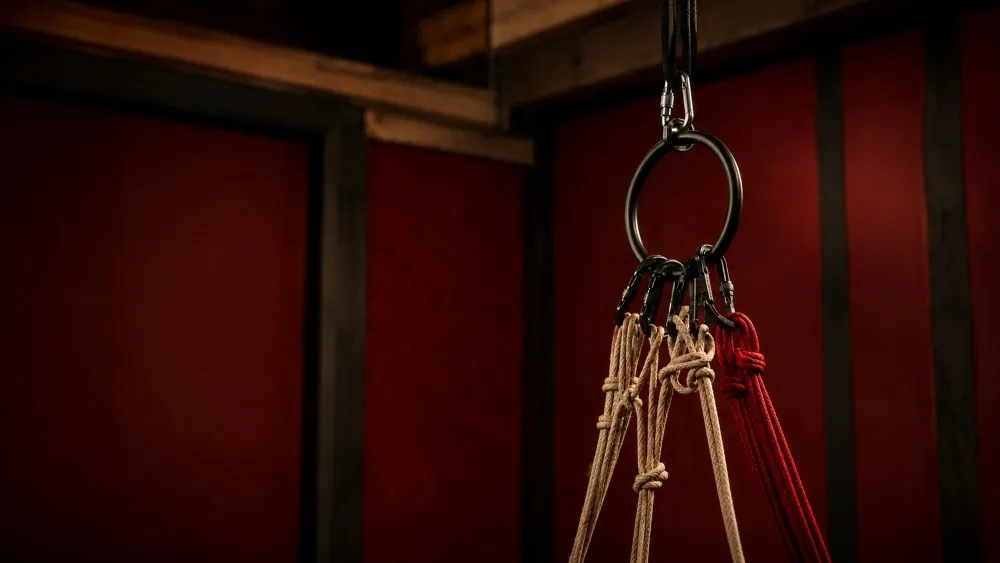
Suspension rings are used to organise and support lines from above. Wooden rings can be used in some rope setups, but they create more friction and need to be suitable for the job. Steel rings are often stronger and smoother.
Swivels allow rotation, which can make suspension feel more fluid and visually appealling. They can also make rigging more complicated because the submissive may spin slightly while being tied or adjusted. That might sound fun, and sometimes it is, but it also means the rigger needs better control over the setup. Add a swivel, carabiners, and connection points, and suddenly your rigging system takes up more vertical space.
Suspension cuffs are designed to distribute pressure more safely than ordinary cuffs. They can be useful in certain suspension scenes, especially where wrists or ankles are involved, but they still need to fit properly and be used correctly. Cheap cuffs, flimsy straps, or novelty restraints should stay exactly where they belong: in the drawer.
What Rope Should Be Used for Suspension?
For many riggers, hemp is a popular choice because it's strong, reliable, and holds knots well when prepared properly. Multi-fibre polypropylene, often called MFP, is also used by some people because it is strong, washable, and predictable. Many suspension ropes are around 6mm to 8mm thick, which gives a useful balance between grip, comfort, and manageability.
Jute is also used in rope bondage and can be beautiful to work with, but it tends to be lighter and less forgiving depending on quality, treatment, and intended use. Some experienced riggers use it for suspension, but beginners should not assume every rope sold is suitable for lifting body weight.
Ropes that are often better kept away from suspension include cheap nylon, cotton, bamboo, decorative rope, or mixed fibre rope of unknown quality. A rope that is perfectly fine for tying wrists to a bed might be completely unsuitable for holding a person in the air. It also needs to be clean, inspected, and maintained. Rope can weaken through age, friction, moisture, bad storage, contamination, poor treatment, or repeated heavy use. If a rope looks damaged, feels inconsistent, smells odd, has flat spots, or shows fraying, it should not be trusted in suspension.
Want more details on rope feel and material choice? Read our guide comparing jute and hemp rope, and determine which is best for bondage.
Chest, Hip, Thigh & Ankle Harnesses
The chest harness is often one of the most important parts of the setup. It can take a major share of the body’s weight and helps stabilise the upper body. But it has to be positioned carefully. Too high, too tight, too loose, or badly tensioned, and it can affect breathing, pinch nerves, or shift under load.
The hip harness helps support the pelvis and can make the suspension feel more balanced. It can take some strain away from the chest and upper body, especially in horizontal suspensions. When done well, it helps the submissive feel held rather than dragged into position by one overloaded point.
The thigh harness can carry a significant amount of weight, especially when lifting or controlling the lower body. The thighs have more padding and muscle than wrists or ankles, which makes them useful support areas. Poor placement, however, can still compress nerves, restrict circulation, or create nasty pressure.
The ankle harness is often used to control position, angle, or comfort rather than carry the main weight. It might help lift or separate the legs, support a line, or keep the body arranged in a particular shape. Used badly, though, ankle ties can quickly become uncomfortable because ankles are not designed to take a heavy load for long periods.
How to Tie Off a Suspension Ring
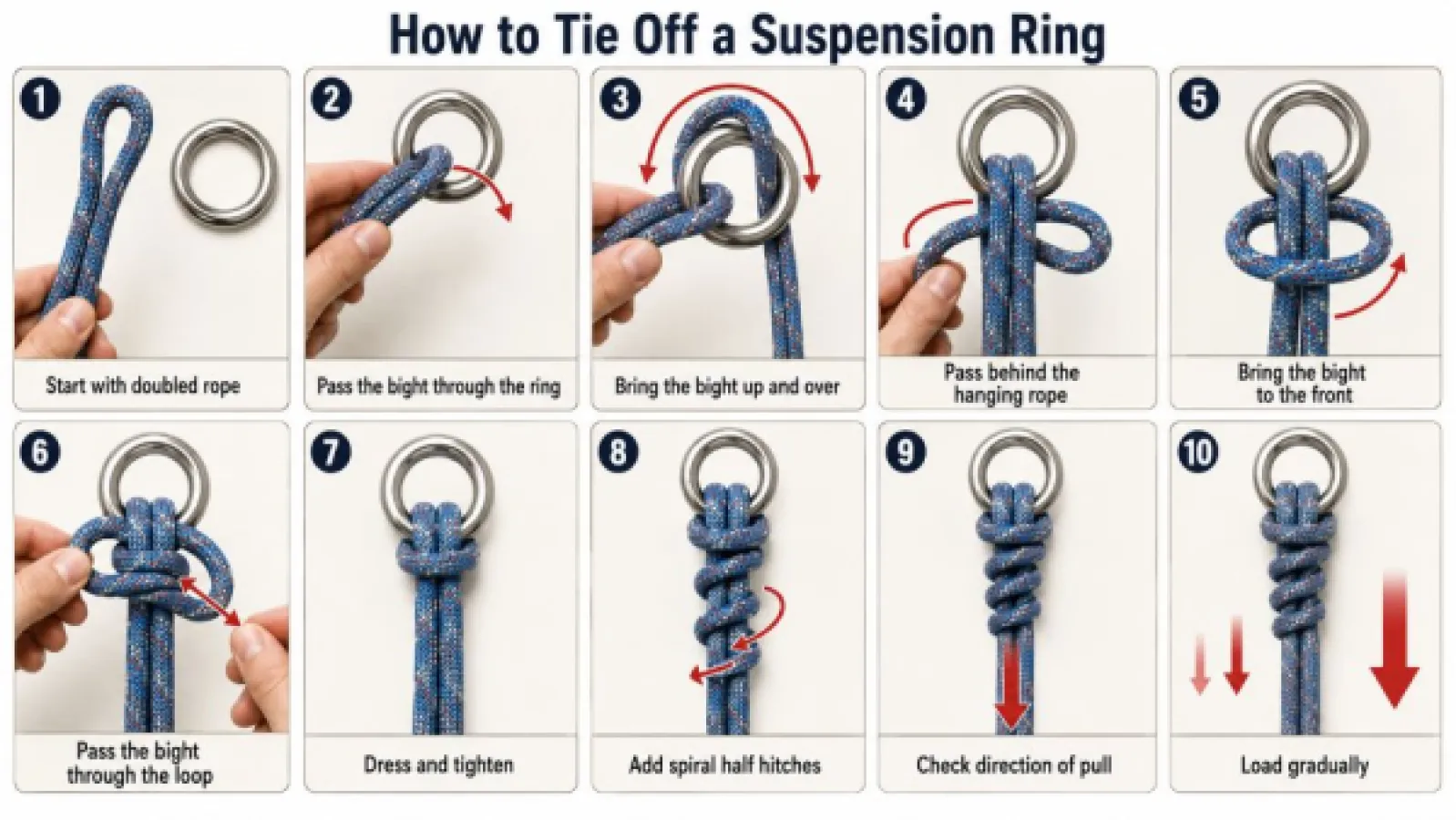
Step 1: Start with doubled rope
Most suspension rope is worked as a doubled line. That means the rope is folded in half, so you have a bight at one end and two working strands running together. This gives the rigger a stronger, cleaner line to work with and helps keep tension more even. Hold the doubled rope behind or below the suspension ring, with the looped end sitting close to the ring and the two long strands hanging down.
Step 2: Pass the bight through the ring
Take the looped end of the doubled rope, also called the bight, and pass it through the inside of the suspension ring. You should now have the loop coming through the ring, while the two long strands remain on the other side.
Step 3: Bring the bight up and over the ring
Once the bight has passed through the ring, bring it up over the outside of the ring and back toward the hanging rope.
Step 4: Pass the bight behind the hanging rope
Take the bight behind the two hanging strands. This creates the wrap needed for the overhand structure. At this point, you should see the ring sitting inside the developing knot, with the doubled rope wrapping around itself.
Step 5: Bring the bight back to the front
After passing behind the hanging rope, bring the bight back around to the front. You should now have a clear loop forming around the standing part of the rope. The knot is almost there, but it is not secure yet.
Step 6: Pass the bight through the loop
Now pass the bight through the loop you have created. This completes the running overhand knot around the suspension ring. Pull the knot down firmly so it seats against the ring. Tighten it with control, making sure both strands of the doubled rope tighten evenly.
Step 7: Dress and tighten the knot properly
Look closely at the knot. The two strands should sit together neatly. Nothing should be crossed, twisted, pinched oddly, or hidden inside the knot where you cannot inspect it. A neat knot is easier to check, easier to load, and easier to understand if something needs adjusting. Once everything is sitting correctly, tighten the knot again. The rope should grip the ring firmly without sliding around loosely.
Step 8: Reinforce with spiral half hitches
The overhand knot creates the main attachment, but many riggers then reinforce the tie-off with spiral half hitches down the hanging rope. To do this, take the working bight or loose doubled section and wrap it around the standing rope below the ring, passing it through itself each time to create a half hitch. Then repeat this in a neat spiral down the rope. Each hitch should sit snugly beneath the previous one, creating a tidy chain of reinforcement.
Step 9: Check the direction of pull
Before this is used for any kind of suspension, the rigger needs to check how the rope loads. Pull down gently on the hanging line and watch what happens. The knot should tighten into the ring, not roll awkwardly, slip, twist, or open. The hitches should stay seated. The rope should run cleanly from the ring to the line below. If anything shifts in a way that looks odd, the setup needs to be undone and retied.
Step 10: Load it gradually before any real suspension
First, add light downward tension by hand. Then add more pressure and check again. If this is part of a partial suspension, the submissive’s weight should be introduced slowly while the rigger watches the knot, ring, hitches, anchor point, and rope angle. If the knot tightens neatly and stays where it should, good. If it slips, rolls, jams strangely, or becomes difficult to inspect, it's all wrong. Untie it and start again.
Can Beginners Try Suspension Bondage?
Beginners should really start with the basics: floor bondage, simple rope positions, cuff restraint, body awareness, communication, and understanding how pressure feels. After that, partial suspension can be introduced in a controlled way with someone who actually knows what they are doing.
A first suspension experience should be short, simple, and carefully watched. The aim is to learn how the body responds when the rope starts taking weight. A beginner might try a supported lean, one lifted leg, a chest harness taking partial load, or a position where the feet remain close to the ground. This gives the submissive a taste of suspension without asking too much from the body too soon.
Want to test out your limits on your own? Best not to. Self-suspension is far riskier than many people realise. If something goes wrong while someone else is rigging you, they can lower you, cut the rope, adjust a line, or help immediately. If something goes wrong when you're alone, tangled, panicking, or unable to reach the release point, things can become very dangerous... very quickly.
For more on limits, warning signs, and restraint safety, read our blog on how long is too long in bondage.
Aftercare Once You’re Back on the Ground
One moment, you're floating, held, displayed, and helpless. Next, your feet are back on the ground, and your body has to remember how standing works. A submissive may feel wobbly, emotional, cold, shaky, euphoric, quiet, floaty, or slightly confused after suspension, which is completely normal after an intense session.
First, check the body properly. Look at the wrists, arms, chest, ribs, hips, thighs, ankles, and anywhere the rope carried weight. Red marks are common, whereas deep grooves, swelling, numbness, sharp pain, weakness, or skin that feels hot and damaged need more attention.
Move slowly and stretch gently if appropriate. Drink water and eat something small if your blood sugar feels low. Some people want cuddles and reassurance, whilst others want quiet, space, or to sit at Mistress’s feet while they come back to themselves. Aftercare doesn't necessarily have to be sentimental, but it does need to suit the person.
For more recovery advice after intense BDSM sessions, read our guide to impact play aftercare.
Ready to Explore Suspension Bondage?
Suspension bondage can be one of the most powerful forms of BDSM restraint... one that's undeniably beautiful, strict, exposing, erotic, and deeply psychological. It does, however, demand skill, preparation, communication, suitable equipment, and a Mistress who knows the difference between helplessness and actual risk.
If you are ready to explore bondage with women who understand restraint, browse our full gallery of London Mistresses and choose the Domme you'd trust to lift you, hold you, watch you, and decide when you finally get to touch the floor again.
Still building your confidence? Start with our beginner-friendly domination services guide before asking Mistress to turn you into her favourite hanging little plaything.